Monday, 11 April 2016

Madrid


Each year as winter starts to loose its grip on us we look for a place to visit the sun. This year we visited Madrid for a four day weekend to celebrate Easter where we enjoyed the wonderful people of Spain, warm sun, blue skies and many observations of Easter.

We began our explore with a walk to Plaza de Cibeles in search of the famous Cibeles Statue and fountain.  We found the statue but the fountain was not operating…oh well. The Cibeles Statue is one of the most recognizable icons in the city. This is the place where Real Madrid football fans celebrate big wins, and they do have lots of reasons to celebrate. The statue placed here in 1782 is Goddess Cybele driving a chariot pulled by lions. It sits in a square in front of the very impressive City Hall building that was built in 1909.
City Hall


We ventured on to find the Puerto del Sol, the Gate of the Sun which is one of the busiest and most recognized places in the city. This large square is the center of a radial network of roads and is marked as Km 0, the starting place to all roads from here. This was once one of the gates of the city wall which protected Madrid in the 15th century. The gate was named for the rising sun as this was the eastern entrance of the city. Today it is a popular meeting place with a number of notable monuments, crowds of people and plenty of entertainment including musicians, showmen and all manner of character actors.

The most famous symbol of the city is also prominently displayed here, a statue of a bear eating fruits from a tree, officially "El Oso y EL Madrono". Madrid was originally called Ursaria, or the land of the bears, because the surrounding forests were quite full of bears. Today the Bear and the Strawberry Tree are recognized as the symbol of Madrid.

A Mariachi Band at Puerto del Sol


Next for us was the Plaza Mayor and lunch. The Plaza Mayor is very large and colorful and considered the center piece of Madrid. You just can't visit Madrid and not visit this place. 

This place has a long history, not all of it pleasant. Of course it's a great place for big celebrations and in the past was even home to bull fighting and football games. More infamously, during the Spanish Inquisition the Plaza saw the ritual of public penance, "autos de fe", imposed upon supposed heretics, or if penance was not in order, the executions of those condemned to death. We are glad to report that those days are long past and that everyone we met was extremely friendly.

Today Plaza Mayor is a fun place to visit surrounded by distinct architecture with many wonderful outdoor cafes. We enjoyed a couple of relaxed lunches here; tapas, paella and a beverage or two in the warm sun while taking in the sights. 
The colorful buildings of Plaza Mayor


Sights along the Gran Via, the Main Street of Madrid with great buildings, shops and lots of people. The Principal Hotel where we stayed is the building on the right. The Rolex building is to the left, the Metropolis would be to the extreme left.
The Royal Palace was built here on the site of a Moorish fortress or Alcazar. The palace was completely destroyed by fire in 1734. It was rebuilt from 1738 to 1764  uniquely constructed of all stone and brick with no wood to guard against a future fire.


Right next to the Palace, Cathedral de La Almudena was a long time in the planning and was also under construction for a very long time. Built on the site of a medieval mosque that was destroyed in 1083 when Alfonso VI reconquered Madrid, construction of this structure began in 1879. The project was abandoned during the Spanish Civil War and then restarted in 1950. The cathedral was finally completed in 1993. It was consecrated by Pope John Paul II. The interior is Neo-Gothic and is a modern place of worship. We visited during the day and then went back at night during evening services.

Cathedral de La Almudena
The Palace at night
We were told that Madrid is the place to find traditional Flamenco. We asked for some help and were directed to Corral de la Moreria as host to one of the best Flamenco shows in the city.

We had a great time. We enjoyed a lovely traditional Spanish meal and were treated to an outstanding show of classic guitar, singing and, of course, lots of dance. The artists are first class professionals and the passion they bring to their presentation of Flamenco certainly distinguishes them and their art form. 


Puerta de Toledo
Metropolis
Museau de Prado
We really enjoy strolling through art museums and spent the better part of the next day at Museau de Prado. This is the largest museum in Spain and holds a collection of 7600 paintings, 1000 sculptures, 4800 prints, and 8200 drawings of which about 1300 are on display…wow. We did our best to see it all but we are sure we missed some. Artists include Francisco de Goya, Diego Velazquez, Peter Rubens, and Hieronymus Bosh among many, many others. We had a great day.
Museau de Prado


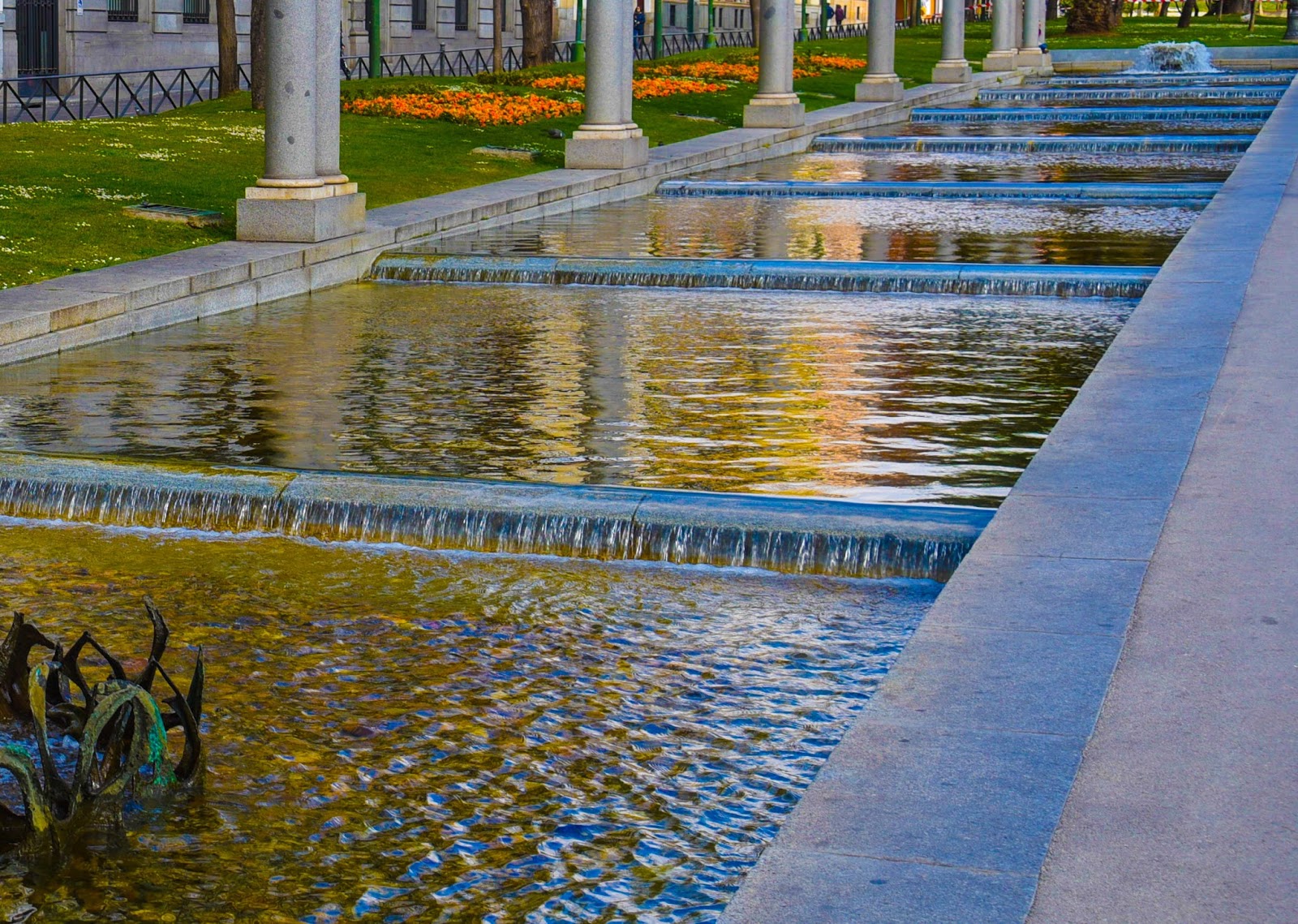
There are great fountains all over the city of Madrid. Just a short walk from the Prado is this fantastic fountain, Fuente de Neptuno, the fountain of Neptune. It is located in the Plaza de Canovas del Castillo. It depicts Neptune on a conch shell chariot being pulled by sea horses. 


The steps of the National Congress 
We walked all around Madrid enjoying the sights and checking out the statues that adorn the buildings. Here are a few of our favorites including the Lion guarding the Congress of Deputies (National Congress), the Winged Victory which sits on top of the dome of the Metropolis Building and the Minerva from the deck of the Circulo de Bellas Artes Building. In all during our visit we walked about 16 miles through the city. Madrid is a great city with lots of parks and gardens full of beautiful fountains and sculptures.
We had a great time in Madrid. We found the sun!  The food of madrid is great, the sights of Madrid are great. But above all the people of Madrid are fantastic!
BBVA Bank Building Quadrige (four horse chariot) Sculptures
atop the Ministry of Agriculture


Tuesday, 9 February 2016

Iceland the Great Outdoors

We were looking for a special place to celebrate one of those birthdays that end in a "0".  A January trip to Iceland, with a few days out in a four wheel drive to check out the dramatic scenery, was just right for creating great memories. We had hoped to see the Aurora Borealis, the Northern Lights, however the weather did not cooperate and, despite driving around in the cold dark night until 2:00 a.m., we saw almost nothing. Maybe next time…

We did however explore some fantastic sites ranging from great waterfalls and massive glaciers to entertaining geysers and a beautiful black sand beach. Iceland is a special place of crisp clear air and volcanic land formations that pop right up out of the sea. The language here is Icelandic and we tried to pick up a few words but were happy that everywhere we went people spoke to us in English. The people here are wonderful hosts and the food was great, especially if you like fish.
Our first stop on our explore was here at Seljalandsfos which is one of the most photographed waterfalls in Iceland. You can walk behind the waterfall and when you do you are treated to some really special views.

The waterfall drops more than 60 meters (approximately 200 feet) over the cliffs that once formed the
coastline and tumbles into a beautiful pool. We climbed up to vantage points on the cliffs and made our way around and behind the falls. We got good and wet but we were prepared so no worries…it was great!


View from behind the falls

Icelandic Horses

Everywhere we went we found Icelandic horses. These horses were developed from ponies brought here in the 9th and 10th centuries by Norse settlers, and today are unique to Iceland. By law no other breed of horse is permitted on the island, and those horses that are exported are not permitted to come back, protecting the breed. They are not very tall but they are known to be long-lived and hardy. They seem perfectly happy living out in the elements. They are often used to help in minding the sheep, whilst some are used for racing and for show. They are known for having five distinct gaits in contrast to three gaits for most horse breeds. The one we approached was not at all shy and came right up to us to get some attention.


Next up, Skogafoss on the Skoga river one of the biggest waterfalls in Iceland. It is 25 meters (82 feet) across and also drops more than 60 meters (about 200 feet) from the top of the cliffs. The waterfall creates a constant spray and a nice rainbow when the sun shines. A local legend claims that one of the first Viking settlers buried treasure behind the falls. We didn't find any buried treasure but we did find the sun and the rainbow.


A Walk to the Glacier

After exploring the falls we went off to find a glacier. We were told that the blue ice we found at the toe of the glacier takes some 200 years to find its way from the top. The ice brings along volcanic debris creating a contrast of black, blue, and white, very nice.
We walked along a trail that lead us next to a glacial lake and right up to the ice. There were groups of people all kitted out headed for a climb on the glacier. Once we got up close to the ice we got to appreciate just how massive it is.


The biggest ice cubes we have ever seen...

Vik and its Black Sand Beach

After exploring the glacier we set off to the small village of Vik i Mydal or just Vik. This is the southernmost village in Iceland and is host to a very nice black sand beach. We arrived as the sun was headed toward the horizon and we were treated to a nice sunset. The beach at Vik has been included as one of the ten most beautiful beaches on Earth by the US journal Islands Magazine. The cliffs are home to many migrant birds and at times are filled with nesting puffins.

Basalt rock stacks rise above the surf indicating where the cliffs once protruded into the sea. The black basalt sand provides a striking contrast. This is also known to be one of the wettest places in Iceland. Folklore here tells of trolls that once inhabited the shoreline and of the mischief they created including making off with the boats of local fishermen. The sea and surf here are powerful and there is a monument to remember lost seamen.


We began our next day in Iceland with a visit to the place where the North American and European tectonic plates meet then we were off to find some geysers…

The Geysers


The Strokkur is a fountain geyser in the Haukadalur geothermal area next to the Hvita River. Inside of the geothermal area there are bubbling mud pools, steaming fumaroles, bright colored algal despots and other geysers including the oldest named Geysir, known as the Great Geyser.

Strokkur is amazing and very entertaining, It erupts on a regular cadence every 8 to 10 minutes. It spouts up between 20 and 40 meters into the air (60 to 120 feet). It seemed that no mater where we positioned ourselves the wind would shift and the steam would come after us. When the geyser erupts high in the air the wind takes the hot water and sends it flying. We got soaked more than once but that didn't sway us from hanging in there to watch the show.

The first written record of Strokkur eruption was in 1789. Over time through a number of earthquakes and volcanic eruptions the geyser has gone dormant and then become active again. In 1815 it was measured to spout 60 meters into the air (180 feet). It has now been active continuously since 1963.


From the Geyser we continued along what is called the Golden Circle to one of most popular sites in Iceland, Gullfoss, or Golden Falls. The falls are situated in the canyon of the Hvita river. There are three large and distinct drops forming a stair case and then the river drops out of site as it plunges into a crevice that is 32 meters (105 feet) deep. Because we were here in the middle of winter the paths were covered in ice. Luckily our guide provided us with ice spikes and we were on our way to appreciate the power of the river as it crashes its way along.


From here we were off to the highlands to play in the snow and to work our way up to a glacial ice cap.


Our local guide ready to extract a stuck vehicle with a tow rope
We started in the mud but before long we were in snow country. Along the way several of the four wheel drive vehicles got stuck, putting us in rescue mode. We encountered some white out conditions that kept us from going all the way to the top but we did get well up the mountain.
Following up into the Highlands
Our guides enjoying a bit of
late afternoon sun!

Stuck in the snowbank…
We ended our day by taking an unscheduled detour to
 visit a beautiful lake with a hot spring bath. We
were longing to try out the sauna, fed by the steaming water, but, alas,
we had  neither the time nor swimming costumes.