Tuesday, 5 July 2016

Mykonos

With sunshine for as many as 300 days each year, and rain generally only in February and March, Mykonos seems like a Greek paradise! We were here on a postcard perfect day and really enjoyed our time on shore.


DSC_1272.jpg
This pretty harbor is lined with shops and restaurants: a great place to relax!

DSC_1220.jpg
DSC_1225.jpg
Great fun for lunch with wonderful hosts!
DSC_1230.jpg


DSC_1235.jpg
Mykonos is known for it’s windmills. Scott did a fairly long, mostly uphill, walk to find this one!

DSC_1240.jpg


DSC_1249.jpg
This little church was at the top of Scott’s long walk.
DSC_1245.jpg
Our wee boat looks rather large in this small harbor.
DSC_1250.jpg
Shopping…Mykonos style

DSC_1251.jpg


DSC_1268.jpg
A few of the iconic windmills of Mykonos! There are actually 16 windmills scattered throughout the island, but these are probably the most well known as they are easily viewed from the harbor.

DSC_1264.jpg
DSC_1255.jpg
DSC_1269.jpg
DSC_1271.jpg
 We left the harbor on a tour boat that took us to the island of Delos and an amazing archeological site.
Delos is a tiny island with a big past. In Greek mythology it is said to be the birthplace of Apollo and his sister, Artemis, making it a very sacred place. People have lived here since many millennia before the birth of Christ. In about 167 BC it was designated as a free port and became the center for trade and commerce in the eastern Mediterranean. A thriving community of wealthy merchants, bankers, and ship owners, it eventually became the greatest commercial center in the world.
Unfortunately for the people who lived here, it also became an attractive target! Attacked and looted twice, the city fell into ruin.
One of the unique things about this island is that, once deserted, nothing was ever built over the existing structures. Archaeologists have been excavating here since 1872, unearthing all sorts of structural remains and objects, all pointing to a very wealthy society.
The entire island is an archaeological site, and excavation and preservation are on-going.
DSC_1206

Santorini for a second look


What might you get when a big volcano has an enormous eruption? How about a giant lagoon surrounded on 3 sides by steep cliffs reaching up to as much as 300m (980 ft.). . . and what we know as the island of Santorini!

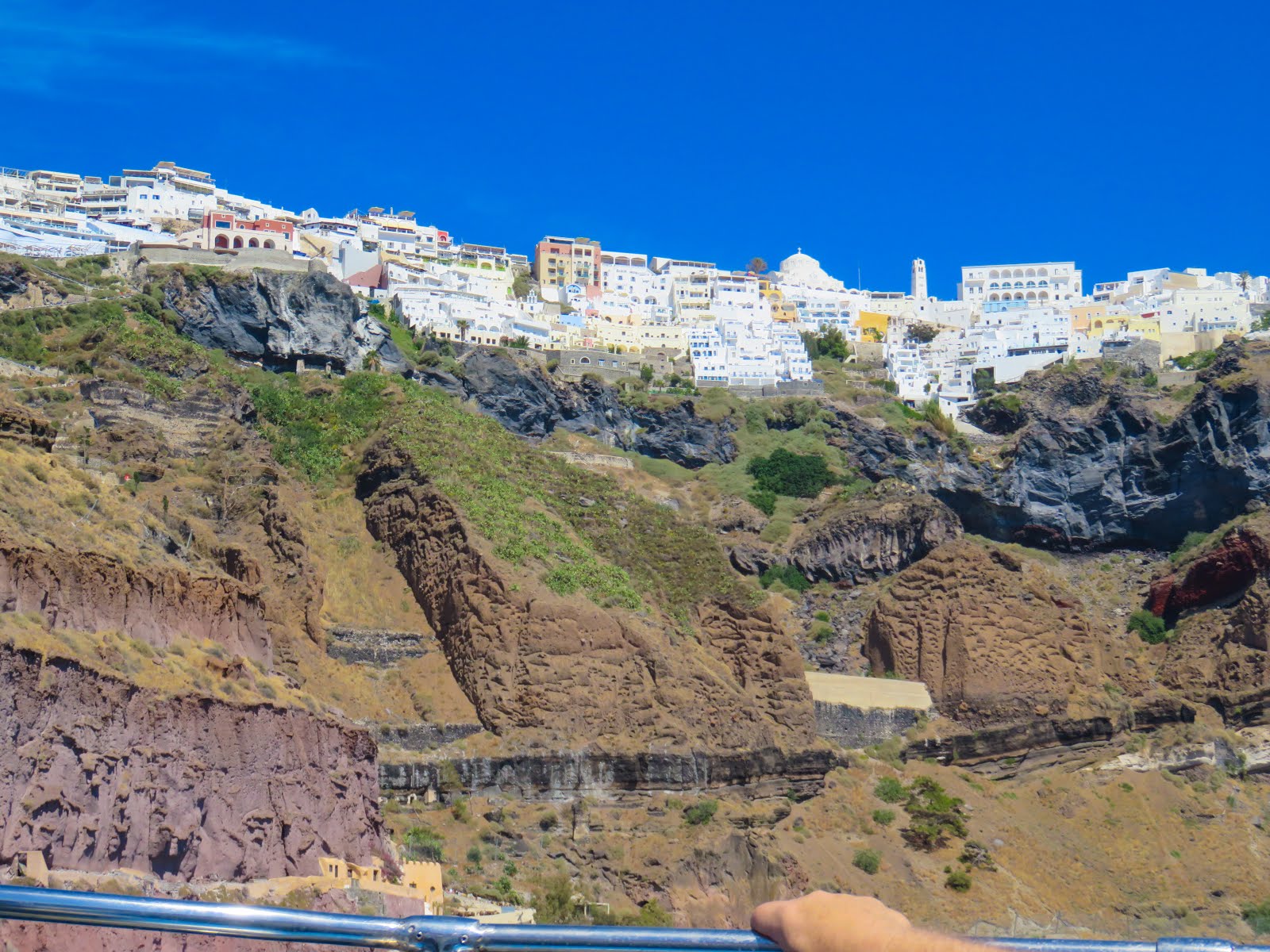
We are headed up to the top of the cliffs to explore the village of Fira
the village of Fira


We had a nice lunch at a friendly and familiar place where we celebrated an anniversary a few years ago. That wee boat in the distance is ours :)!
This nice cable car was our way back down the cliffs and back to our boat, and we even had tickets in our pocket, but there were four ships in port and the wait was unreasonable…
so, we walked down the steps, all 588 of them! This route is shared with the donkeys, making it a bit “interesting”. We had to fend them off a time or two and more than once had to move to the side of the steps for a line of these animals to pass, making their way up, or down.


Almost at the bottom with the famous, but quite smelly, Santorini donkeys


We also explored the really great archeological site of Akrotiri, a Minoan Bronze Age settlement currently being excavated on Santorini. 


This settlement was destroyed in 1627 BC by the ash from a volcanic eruption. Similar to what happened in Pompeii, being covered in ash, while not at all good for the inhabitants, actually preserved many artifacts and art works, including some beautiful frescoes.


Excavation work had been halted for quite some time on this site for financial reasons. Money was eventually found, and the archaeologists were able to get back to work on the very day we were there.


Athens


Scott and I have made an annual habit of taking a week off and traveling somewhere in Europe. This year, we decided on a cruise which included some Greek islands, Sicily, and Malta. Our cruise departed from Athens and we took an extra full day to relax and enjoy the city beforehand.

We began our day with a "leisurely" two mile stroll from our hotel though the streets of Athens to the Acropolis. Our walk tool us past the Panathenaic Stadium (the old Olympic Stadium). 

Looking across the ruins of the ancient Agora to the Acropolis I realized that we still had a bit of a walk ahead of us.....


A long walk and an up hill climb brought us to a final set of stairs. Consider the effort it must have taken to get all of that stone to the top of the Acropolis!


From the Acropolis the views over Athens are incredible!
After walking around on the Acropolis, we began our descent through the Agora. This area, the center of ancient Athens, was used for a variety of things and included government buildings as well as a market. 


Dating from the late 10th century, The Church of the Holy Apostles is one of the few remaining intact structures.


The Temple of Hephaestus sits on a hilltop overlooking the Agora.

We eventually made our way through the Agora and out into the Plaka. This area of Athens is renowned for its markets, shops, and cafes. 
DSC_1105

DSC_1106


Before we set out for the day we asked about a nice place for dinner. Our requirements included good food and a nice view. We think they did a pretty nice job for us!