Tuesday, 5 July 2016

Isle of Skye ... again :)

As we get near the Skye Bridge we pass Eileen Donan Castle .
On a recent bank holiday weekend we decided to make a return visit to the Isle of Skye. We had been here before, a few years ago, in absolutely dreadful weather. Our return trip was blessed with warm sunshine so we were able to get out and enjoy the sights, and managed a couple of nice hikes as well.

There are many stories about Skye. The island has a permanent place in the history of Scotland as the location where Flora MacDonald helped Bonnie Prince Charlie escape as he fled the English army after the battle of Culloden. Skye also has a rich history of folklore, especially stories of fairies. We explored a fairy glen, hiked to the fairy pools, and even saw a fairy flag at Dunvegan Castle. As usual, Scott took some outstanding photos to help tell the story of our visit to Skye.


Kilt Rock is actually a sea cliff! It’s name comes from the shape of the vertical rock. With a little imagination one can almost picture a kilt here…

The Mealt Waterfall flows from the cliffs here, and drops a breathtaking 60 meters!


We arrived on Skye around noon,  and decided to go for a drive to Neist Point Lighthouse. We learned just how big the island is! Neist Point is the most westerly point on Skye. After driving for over an hour, often on single track roads, we reached the car park and began a hike to find this beautiful place.


The magical formations of the Quiraing were formed by a land slip. In fact, the land is still moving and the road requires repairs each year. 


We have met some folks originally from Skye and they told us we must take a trip on “The Bella-Jane”. The boat ferries passengers across the water to the remote Loch Coruisk, a fresh water loch at the foot of the Black Cuillin mountains. Getting from the boat dock to the Loch required a bit of a hike, but it was well worth the trip! Supposedly a water horse lives in this loch. No sign of her today, though :)!


Loch Coruisk


Watching for wildlife on our return trip. We did see some lazy seals.

I have not forgotten about the fairy stories, mind. Towards the end of the day we set off on a hike to find the fairy pools. It was a long, hot hike, but the pools were breathtaking in the late afternoon sun

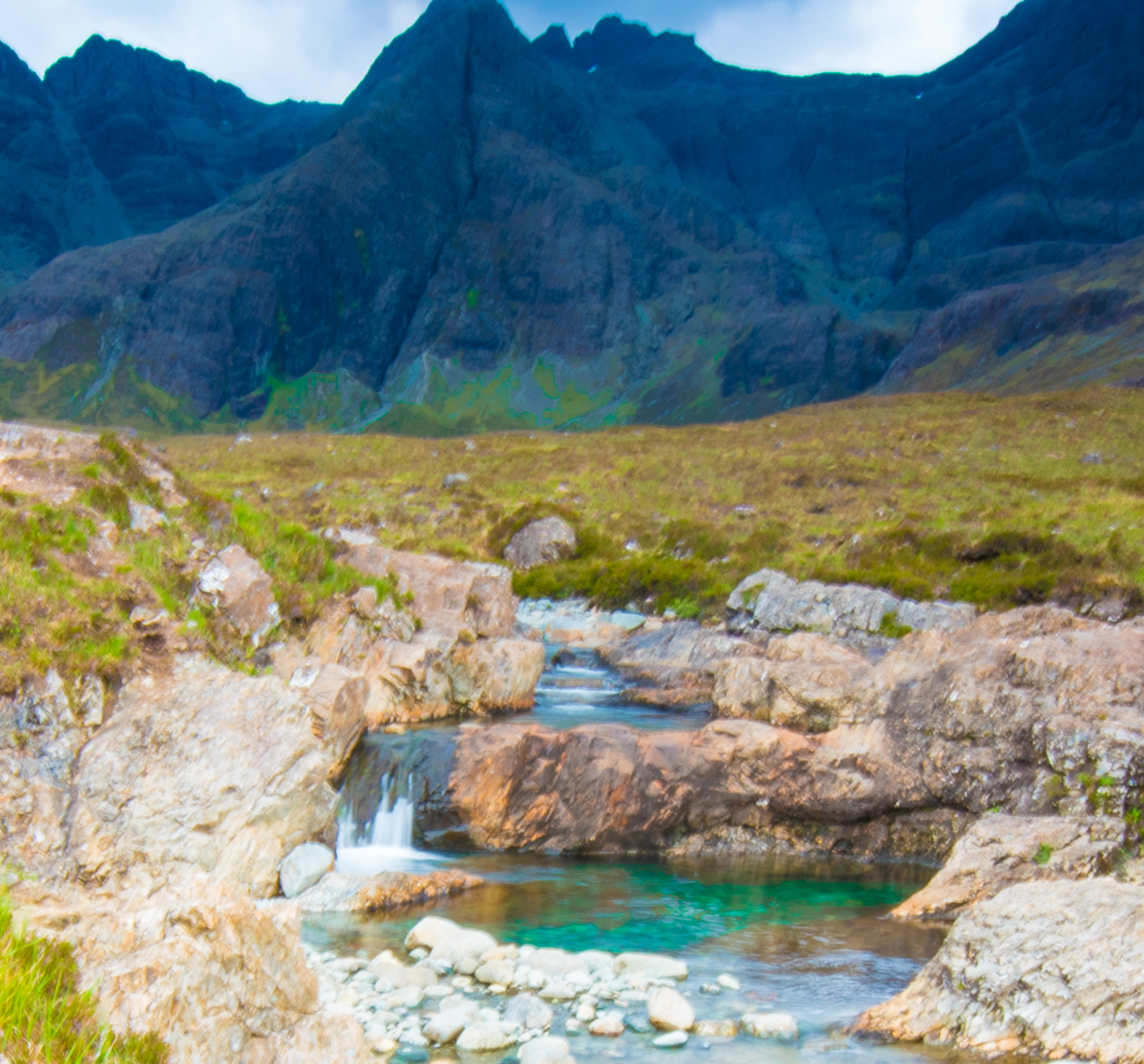
The walk to find the Fairy Pools starts here.


Whilst our walk to the fairly pools began with a steep downhill walk and then, a mostly gentle, uphill path, that could not be said for the walk back, which somehow seemed longer and mostly uphill, lol. Surely the fairies could do something about that? And, yep, those boulders ARE the way across!

Strange land formations and other odd sights that defy explanation can only mean one thing…we have found the Fairy Glen!


Our second day on Skye we had signed up for a tour, which allowed Scott to enjoy the beautiful scenery rather than concentrate on the largely single track roads. At one point we split up; he returned to Neist Point for a long hike and some more photos and I chose to explore Dunvegan Castle and Gardens. It is the oldest continuously inhabited castle in Scotland, and the home of Clan MacLeod. The gardens were just amazing and I definitely enjoyed a beautiful late spring afternoon wandering here.


Dunvegan Castle is also home to a “Fairy Flag”. No one really knows the origins of this flag which now is quite worn and tattered. Most of the stories have something to do with a gift from the fairies, and magical powers have long been associated with it.


A few of the beautiful flowers I enjoyed on my walk in the Dunvegan Castle gardens


The Black Cullen Mountains are part of Skye's beautiful landscape!


We had a great time exploring this beautiful island. Fairies or no, there is truly something magical about the Isle of Skye!

Saturday, 21 May 2016

St Andrews


St. Andrews, the golf course, is the most recognized golf course on the planet.  It is the home to The Royal and Ancient Golf Club, the guys who wrote the rules of golf. After all, this is "The Home of Golf " right here on the beautiful east coast of Scotland. While the golf course was not the only reason we came for a visit, it would have been well worth the trip all by itself! This place is fantastic! To see the Claret Jug, walk the Old Course, stand on the Swilken Bridge and to think about all of those fantastic dramas played out on the hallowed ground of the Old Course is truly great fun.  The course has hosted golf since the 15th century and has seen continuous play through all those years, except for a short period from 1457 when King James II of Scotland banned golf because the young men were playing way to much golf and not practicing their archery. That seems to be a problem for many golfers even today… The Course has hosted a record 29 British Open Championships and today hosts the Open on a five year rotation. It is a beautiful place on a beautiful coastline. If you play golf or if you just enjoy watching golf on the television or if you just like beautiful places you just have to come and visit.


The Clubhouse and the sea...
Just had to take this picture!
A famous bridge ....


St. Andrews, the town in Fife Scotland, is more than just home to a famous golf course and we really did see much more than just the golf course during our visit. We started with a stroll around the wonderful campus of the University of St. Andrews. The University was founded around 1410 when Avignon Antipope Benedict XII issued a papal bull to some Augustinian clergy. The school boasts an impressive list of alumni ranging from King James II of Scotland to Protestant Reformation leader and founder of the Church of Scotland, John Knox (1531) to modern day Royals, Prince William, Duke of Cambridge (2005) and Catherine (Kate), Duchess of Cambridge (2005).

St Salvator's Chapel


View across St Salvator's Quad

This youg piper welcomed us to University of St Andrews campus in fine style. As you can see he was putting quite an effort into his rendition.


A short walk down the hill from the University is the St. Andrews Castle, or at least what remains of the Castle. The first castle was built here on a rocky perch between 1180 and 1202 and was home to the region's powerful Bishops. The Archbishops of St. Andrews claimed this as their palace.

From there the castle saw much conflict and changing of hands. During the wars for Scottish Independence the castle exchanged from Scottish to British control and back again. Notably it was held by Bishop William Lamberton Guardian of Scotland and supporter of King Robert the Bruce.

The castle also played a significant role during the Reformation. John Knox recorded the castle and its bottle dungeon as a place where many protestants were tortured and executed. When prominent Protestant preacher George Wishart was imprisoned and then burned at the stake at the Castle the protestants responded by overtaking the castle and executing the Cardinal. Following this, protestants who took refuge in the castle formed the first congregation in Scotland. A long siege followed when mines and countermines were dug through the rocks to both topple and defend the castle. The mines are still here today and we crawled down into them to take a look; a chance to touch history.
The main entrance to the Castle
Views of the North Sea from the Castle
As you can see here the Castle stands today only as a ruin but enough remains to define its past. The vantage point and views of the coastline and out to the North Sea are really good.

Just a little more walking along the seacoast brought us to St. Andrews Cathedral. Construction of the cathedral began in 1158 and continued for over a century. The Cathedral was the centre for the Medieval Catholic Church in Scotland and the seat of the Bishops and Archbishops of St. Andrews. It was destroyed by fire and rebuilt a few times. The advent of the Scottish reformation spelled the end for the Cathedral. In 1559 the building was stripped of its alters and images and as Catholicism was declared illegal, it was abandoned and left to fall into ruin. What remains is still impressive and today it is carefully maintained by Historic Scotland.